

What is Heart Rate Variability: A Practical Guide to Measuring Health
Heart rate variability (HRV) measures the tiny fluctuations in time between each of your heartbeats. You might think your heart beats like a perfect metronome, but a healthy, resilient heart actually speeds up and slows down in subtle, millisecond-by-millisecond increments.
A higher variability here is a good thing—it's a sign that your nervous system is adaptable and ready for anything.
Your Heart Is Not a Metronome
If you see a heart rate of 60 beats per minute (BPM), you probably picture one beat happening exactly every second. But that’s not how a healthy heart works. In reality, the time between those beats might be 0.9 seconds, then 1.1 seconds, and then 0.95 seconds. This natural, healthy irregularity is heart rate variability.
Think about it like this: a rigid, inflexible system is brittle. It breaks under pressure. A flexible system, on the other hand, can bend, adapt to new challenges, and recover efficiently. Your heart’s rhythm works the same way.
HRV gives us a direct window into your body's "readiness." It shows how well your nervous system can switch between high alert and deep relaxation. It’s not a sign of an erratic heart, but a responsive one.
The Science of the Beat
At its core, HRV is all about measuring the time between heartbeats, known as inter-beat intervals (IBIs) or R-R intervals. The real breakthrough in understanding HRV came in the late 1970s when scientists moved beyond just counting heartbeats and started analyzing these tiny intervals from electrocardiograms (ECGs).
This shift unlocked a much deeper understanding of our autonomic health. It led to sophisticated metrics we still use today, like SDNN (which reflects overall variability) and RMSSD (which tracks short-term, "rest-and-digest" activity).
This slight fluctuation is a powerful biomarker because it reflects the real-time commands of your Autonomic Nervous System (ANS)—the system running all your body's unconscious functions. Tracking your HRV helps you answer some critical questions every day:
How well did I recover from yesterday's workout or that stressful meeting?
Is my body actually ready for a tough day, mentally or physically?
Are my habits—like sleep, diet, and alcohol—helping or hurting me?
To get a clearer picture of the basics and how modern wearables track this data, the guide on What Is Heart Rate Variability and How Do Smartwatches Know? is a great resource. By tuning into these subtle rhythms, you gain real insight into your body's resilience and overall capacity to handle whatever life throws at you.
Here’s a quick summary of the core concepts to help you grasp the fundamentals of heart rate variability.
Key HRV Concepts at a Glance
Concept | Simple Explanation | What It Indicates |
|---|---|---|
HRV | The natural variation in time (in milliseconds) between consecutive heartbeats. | A measure of your nervous system's flexibility and resilience. |
High HRV | Your heart rhythm is more variable, showing greater adaptability. | Good recovery, low stress, and readiness for physical or mental strain. |
Low HRV | Your heart rhythm is more consistent, like a metronome. | A sign of stress, fatigue, poor recovery, or potential illness. |
ANS Balance | The dynamic interplay between your "fight-or-flight" and "rest-and-digest" systems. | HRV provides a direct look into which system is more dominant. |
Ultimately, understanding these ideas helps turn what seems like a complex biological process into a practical, daily data point for managing your health.
To really get what your heart rate variability is telling you, we need to pop the hood and look at your body's silent but powerful control system: the Autonomic Nervous System (ANS).
Think of the ANS as the behind-the-scenes operator that manages everything you don't consciously control—your breathing, your digestion, and, of course, your heart rate. It’s the master puppeteer pulling all the strings inside your body.
Imagine your ANS has two main levers that it uses to control your body's energy and response. These two branches are locked in a constant, delicate dance, and your HRV score is a direct window into how well they're working together. One branch revs you up for action, while the other helps you calm down and recover.
The Gas Pedal: Sympathetic Nervous System
First up is the sympathetic nervous system, which you've probably heard called the "fight-or-flight" response. This is your body's gas pedal. When you're facing a stressful situation—a looming deadline, a tough workout, or a real emergency—the sympathetic system kicks into high gear.
It floods your system with hormones like adrenaline and cortisol, cranking up your heart rate, sharpening your focus, and getting your muscles ready to go. This is absolutely essential for performance and survival. But when this system is chronically overactive from constant stress, it's like keeping the gas pedal floored. This suppresses the natural variation in your heart rhythm, leading to a consistently low HRV.
The Brake Pedal: Parasympathetic Nervous System
The other branch is the parasympathetic nervous system, also known as the "rest-and-digest" response. This is your body's brake pedal. It takes over when the threat is gone, helping you to relax, conserve energy, and recover from the stress.
This system is what slows your heart rate back down, aids digestion, and promotes repair and rebuilding. It’s primarily run by the vagus nerve, a critical communication highway running from your brain down through your body. A strong, responsive parasympathetic system is what creates that healthy, high variability between heartbeats.
A high HRV is a clear sign of strong vagal tone. It means your "brake pedal" is working effectively and can quickly slow things down after a period of stress. This points to a resilient, balanced, and adaptable nervous system.
This infographic does a great job of showing how your brain, via the ANS, directly influences the variation between your heartbeats, reflecting your overall health and resilience.
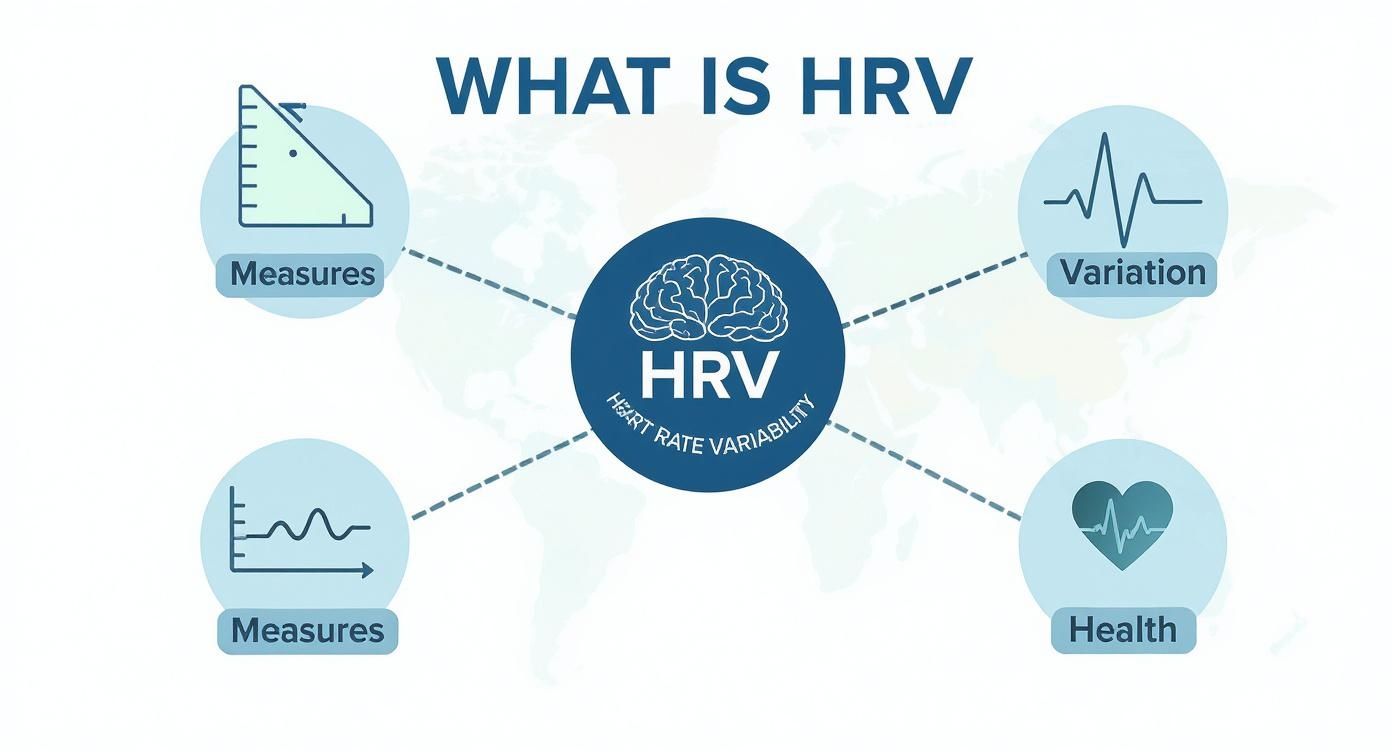
As the visual shows, HRV isn't just some random number; it’s a meaningful metric that connects your internal physiological state to tangible health outcomes.
The Dynamic Balance Between Systems
So, your HRV score is essentially a snapshot of the balance between these two competing systems. It's not about one being "good" and the other "bad"—you need both to live a healthy life. The real key is adaptability: how smoothly you can switch between these states as life demands.
High HRV: This indicates a beautiful, harmonious balance. Your parasympathetic system is active and influential, allowing for greater variation between beats. Your body is responsive, recovered, and ready to adapt to challenges.
Low HRV: This suggests your sympathetic system is running the show. Your "fight-or-flight" response is stuck in the 'on' position, making your heartbeat more rigid and metronome-like. It’s a sign your body is under strain from things like stress, poor sleep, or illness.
This constant push-and-pull is what actually creates heart rate variability. When you inhale, your heart rate naturally speeds up a bit (a sympathetic nudge), and when you exhale, it slows down (parasympathetic influence). The bigger that difference, the higher your HRV and the more resilient you are.
By tracking it, you get a daily report card on how well your body is navigating this crucial balancing act.
How to Measure and Interpret Your HRV Data

Knowing the theory behind heart rate variability is one thing, but the real magic begins when you start tracking your own numbers. This is where abstract concepts become personal, actionable insights into your body's readiness, recovery, and overall resilience.
Thankfully, you no longer need a trip to the doctor's office to measure this powerful biomarker. A whole range of tools now lets you monitor your HRV right from home, each with its own strengths.
Choosing Your HRV Measurement Tool
The gold standard for measuring HRV has always been the electrocardiogram (ECG or EKG). This is what you'll find in a clinical setting, and it provides the most precise data by directly reading the heart's electrical signals. But let's be honest, it's not exactly practical for daily tracking.
For everyday use, we have some fantastic consumer-grade options:
Chest Straps: Devices like the Polar H10 are the next best thing to an ECG. They are incredibly accurate and a favorite among athletes who need reliable data during and after tough workouts.
Wearable Rings and Bands: Smart rings like Oura and fitness bands like WHOOP are designed for passive, round-the-clock monitoring. They typically shine at capturing overnight data, giving you a detailed picture of your sleep and recovery.
Smartphone Apps: You can even use your phone's camera. Many apps, including Mindbreath, use photoplethysmography (PPG) to measure HRV. By placing your finger over the camera lens, the app can detect the tiny changes in blood flow with each heartbeat to calculate its variability. If you have a smartwatch, you can also learn more about extracting HRV from Apple Watch's ECG for a deeper dive into your data.
Decoding Common HRV Metrics
Once you start tracking, you’ll run into a few key metrics. The names can sound a bit technical, but the core ideas are actually quite simple. The most important one to know for daily check-ins is RMSSD.
RMSSD (Root Mean Square of Successive Differences) is your go-to metric for a daily snapshot of your recovery. It specifically looks at the very short-term, beat-to-beat changes in your heart rhythm, giving you a clear window into your parasympathetic ("rest-and-digest") activity.
Essentially, a higher RMSSD usually means you’re well-rested, recovered, and your body is in a state of calm. You might also come across SDNN (Standard Deviation of NN intervals), which measures your overall variability over a longer timeframe (like 24 hours) and provides a broader view of your autonomic health.
To help you get a handle on these terms, here’s a quick breakdown of what the most common HRV metrics are telling you.
Common HRV Metrics and Their Meanings
A breakdown of common HRV measurements and what they reveal about your autonomic nervous system health.
Metric | What It Measures | Primary Indication |
|---|---|---|
RMSSD | The root mean square of differences between successive heartbeats (beat-to-beat variance). | Parasympathetic Activity. A higher RMSSD signals good recovery and a "rest-and-digest" state. This is the most important metric for daily readiness. |
SDNN | The standard deviation of all R-R intervals over a specific period (usually 24 hours). | Overall Autonomic Health. A higher SDNN indicates greater overall variability and adaptability of the heart over the long term. |
pNN50 | The percentage of adjacent R-R intervals that differ by more than 50 ms. | Parasympathetic Influence. Similar to RMSSD, this metric reflects the activity of the vagus nerve. A higher value suggests a more relaxed state. |
HF (High Frequency) | Power in the high-frequency band (0.15–0.40 Hz). | Vagal Tone. This frequency is directly tied to your breathing and is a strong indicator of parasympathetic ("rest-and-digest") activity. |
LF (Low Frequency) | Power in the low-frequency band (0.04–0.15 Hz). | Sympathetic & Parasympathetic Activity. Reflects a mix of both branches. The LF/HF ratio is often used to estimate sympathetic ("fight-or-flight") dominance. |
Understanding these metrics helps you move beyond just a single "HRV score" and start to see the nuances of how your nervous system is responding to your life.
Why Your Personal Baseline Is What Matters
It’s so tempting to Google "what is a good HRV score" and compare your numbers to a chart. Don't do it. This is one of the biggest mistakes people make, because HRV is incredibly personal. It’s influenced by everything from your age and genetics to your fitness level and daily habits.
For instance, someone in their 20s might have an average HRV between 55-100 ms, while for a healthy person in their 60s, a range of 25-45 ms is perfectly normal. An elite athlete could have a baseline that's double that of a sedentary person of the same age.
The real power of HRV comes from tracking your own trends over time.
Establish Your Baseline: Take your reading at the same time every morning (ideally right after waking up) for a couple of weeks. This will give you your personal average.
Look for Trends, Not Spikes: Don't get hung up on a single day's number. Life happens. Instead, watch your weekly average. Is it generally trending up, down, or holding steady?
Connect the Dots: When your HRV takes a nosedive, think about why. Was it a late night? Alcohol? An unusually stressful day or a killer workout? When it trends up, what did you do right?
By focusing on your own data, your HRV score stops being just a number and becomes a personalized guide. It’s your body's way of telling you when you're ready to push hard and—just as crucial—when it’s time to ease up and focus on recovery. That self-awareness is the true power of HRV.
Why HRV Is a Powerful Biomarker for Your Health
Tracking your heart rate variability is so much more than just another fitness trend. Think of it as your body's internal dashboard, giving you objective, real-time feedback on your resilience and overall health. It shows you exactly how well you're coping with everything life throws at you—from tough workouts and work deadlines to a bad night's sleep.
HRV cuts through the noise of just feeling "tired" or "stressed." It gives you a hard number that reflects your body's real capacity to adapt. This data puts you back in the driver's seat, letting you swap guesswork for a truly responsive health strategy.
An Early Warning System for Your Body
One of the most powerful things about HRV is its ability to act as an early warning system. A consistently low HRV can be a red flag, often popping up before you even consciously feel like something is off. It's a clear signal that your "fight-or-flight" system is stuck in overdrive, leaving very little room for your body to rest, repair, and recover.
When you're stuck in that state of chronic stress, it can be a precursor to some serious health challenges:
Chronic Inflammation: A suppressed parasympathetic system can fuel systemic inflammation, which is a root cause of many long-term health problems.
Cardiovascular Strain: A rigid, less variable heart rhythm is a classic sign of a cardiovascular system under duress.
Mental Health Struggles: Low HRV is strongly connected to conditions like anxiety and depression. It reflects a nervous system that's constantly on high alert. For a deeper look at this, check out our guide on stress and its impact on heart health.
In clinical settings, heart rate variability is a huge deal. It's used as a major predictive biomarker for cardiovascular health, especially when it comes to risks after events like a heart attack. Metrics like RMSSD, which directly reflects your "rest-and-digest" activity, are strongly linked to autonomic health. A drop in HRV is often a clear indicator of impaired autonomic function.
Optimizing Performance and Preventing Overtraining
For athletes or anyone serious about their fitness, HRV is an absolute game-changer. It helps you walk that fine line between pushing your limits and getting the recovery you need—which is where all the real gains happen. Waking up to a high HRV score is a green light, telling you your body has bounced back and is ready for a solid workout.
On the flip side, a sudden or sustained drop in your HRV is a clear warning. It’s a sign that you’re piling on fatigue faster than you can recover, putting you on a fast track to overtraining, injury, and burnout.
By listening to this feedback, you can make smart adjustments on the fly. Maybe you swap that high-intensity session for a light recovery day or double down on sleep and nutrition. This data-driven approach helps you train smarter, not just harder, leading to better performance and keeping you in the game for the long haul.
A Personalized Guide to Your Lifestyle
At the end of the day, your HRV score is a direct report card on how your body is handling your unique lifestyle. It takes all the generic wellness advice and makes it personal.
Did that late-night pizza mess with your recovery? Check your HRV.
How did that extra hour of sleep really affect your readiness? Your score will tell you.
Is that new meditation practice actually making a difference? Watch for an upward trend.
When you see HRV as a measure of how you're handling all of life's stressors—your diet, your sleep, your emotional state—it becomes an incredibly powerful guide. It turns abstract concepts into concrete, personal feedback, empowering you to build a lifestyle that truly supports your health and resilience.
Actionable Strategies to Improve Your HRV Score
Knowing what HRV is and how to track it is the first piece of the puzzle. Now, it’s time to take the wheel. The goal isn't just to chase a higher number; it’s about actively training your nervous system to be more resilient, balanced, and ready for whatever life throws at you.
The great news? The most effective methods are simple, accessible, and built on consistent daily habits. By focusing on these strategies, you can directly tap into your parasympathetic "rest-and-digest" system, strengthen your vagal tone, and see real, tangible improvements in your day-to-day readiness and long-term health.
Master Your Breath with Resonance Frequency Breathing
One of the quickest and most powerful ways to give your HRV a boost is through controlled, slow breathing. This technique is a direct line to your vagus nerve—the main "brake pedal" for your entire nervous system.
A specific practice called resonance frequency breathing is particularly effective. It involves slowing your breathing down to a rate of about 4.5 to 7 breaths per minute. Hitting this sweet spot synchronizes your heart rate, breathing, and blood pressure, creating a state of incredible efficiency and calm known as coherence.
Here's a simple way to give it a try:
Find a quiet, comfortable spot where you can sit or lie down.
Breathe in slowly through your nose for a count of four.
Breathe out even slower, through your nose or mouth, for a count of six.
Keep this gentle cycle going for 5-10 minutes.
This ten-second cycle gets you to six breaths per minute, which is a common resonance frequency for many people. Apps like Mindbreath can guide you and even help you find your personal resonance frequency, giving you real-time biofeedback on how your breath is directly influencing your HRV.
The impact of this practice is well-documented. Research into HRV biofeedback has shown that as people achieve this state of coherence, their heart's rhythm becomes more orderly and stable. It's a clear physiological sign that you're shifting your nervous system into a state of self-regulation.
Prioritize Your Sleep Hygiene
Sleep is prime time for recovery. It's hands-down the single biggest factor influencing your overnight HRV. High-quality sleep is when your parasympathetic system gets to take over, repairing muscles, locking in memories, and recharging your batteries for the next day.
So, one of the best things you can do for your nervous system is simply improving sleep quality naturally.
To set yourself up for a high-HRV night:
Stick to a Schedule: Go to bed and wake up around the same time every day. Yes, even on weekends. Your body loves routine.
Create a Cave: Make your bedroom as dark, cool, and quiet as possible. Think blackout curtains and a cool thermostat.
Power Down Early: The blue light from your phone and laptop can mess with your body's melatonin production. Try to go screen-free for an hour before bed.
Watch Late-Night Snacks and Drinks: A big meal or alcohol right before bed can disrupt your sleep and tank your HRV.
Embrace Cold Exposure and Mindfulness
Beyond breathing and sleep, a couple of other practices can do wonders for your nervous system's adaptability.
Cold exposure might sound intense, but even a 30-60 second blast of cold water at the end of a shower can make a huge difference. This short, controlled shock is a type of "good" stress (hormesis). It forces your vagus nerve to jump into action to regulate your body's response, which, over time, strengthens your parasympathetic tone.
Key Takeaway: The goal isn't to eliminate all stress. It's to build your capacity to handle it. Think of cold exposure and intentional breathing as strength training for your nervous system.
In the same way, mindfulness and meditation train your brain to be less reactive. A simple 10-minute daily meditation can help you manage emotional responses, keeping your "fight-or-flight" system from getting triggered when it doesn't need to be.
Fuel Your Body for Resilience
What you eat and drink has a direct line to your HRV. If your body is constantly fighting inflammation or struggling with dehydration, it's under stress—and your score will reflect that.
Stay Hydrated: Even being a little dehydrated can cause your HRV to drop. Keep a water bottle handy and sip throughout the day.
Eat an Anti-Inflammatory Diet: Load up on whole foods—fruits, vegetables, lean protein, and healthy fats. Omega-3s, found in fish like salmon, are especially great for your heart and HRV.
Time Your Meals: Try to avoid big, heavy meals too close to bedtime. This lets your body focus on recovery while you sleep, not on digestion.
Many of these strategies pull double duty. For example, slow breathing is also a proven way to lower blood pressure fast in minutes with a breathing exercise. By weaving these simple, powerful habits into your routine, you’re not just improving a number—you're building a more resilient, balanced, and healthier you.
Common Questions About Heart Rate Variability
As you start digging into heart rate variability, you'll naturally have questions about how it all works in the real world. Let's tackle some of the most common ones to help you move from knowing what HRV is to actually using it to improve your health.
We’ll clear up the confusion and make sure you walk away ready to put your HRV data to good use.
What's the Best Time of Day to Measure My HRV?
The gold standard is to measure your HRV first thing in the morning, right after you wake up.
Do it while you're still lying in bed, before you've had coffee, checked your email, or even stood up. This gives you a clean snapshot of your body's "readiness" for the day, reflecting how well you've recovered overnight without the noise of daily stressors.
Consistency is the cornerstone of meaningful HRV tracking. Taking your reading at the same time and in the same position every day (like lying down for two to five minutes) creates a reliable baseline. This routine strips away the variables, showing you the true impact of your sleep, stress, and recovery.
Why Does My HRV Score Jump Around So Much?
It's perfectly normal for your HRV score to fluctuate from one day to the next—in fact, that's what makes it so useful. Think of HRV as a highly sensitive gauge of your nervous system's immediate reaction to your life.
A tough workout, a stressful meeting, a poor night's sleep, or a couple of drinks can all push your system into "fight-or-flight" mode, causing your HRV to dip.
On the flip side, a restful day, a good meditation session, or deep, restorative sleep can send it climbing. The trick is to not get hung up on a single day's number. What you're really looking for are the trends over weeks and months.
A steady downward trend might be a red flag for accumulating stress, overtraining, or even the start of an illness.
A stable or upward trend is a great sign that your body is handling stress well and recovering effectively.
Is a Higher HRV Score Always Better?
For the most part, yes. A higher HRV is generally a sign of good health, fitness, and a resilient nervous system. It means your "rest-and-digest" system is in charge, and your body is primed to adapt to whatever comes its way.
But context is everything. An unusually high HRV, especially when paired with a very low resting heart rate, can sometimes signal deep fatigue or an issue with the heart's electrical system, though this is rare.
Ultimately, the goal isn't to hit some universal "high score." It's about finding your personal baseline and working to keep your HRV stable or trending upward within your own healthy range. An HRV that is high for you is the best indicator of good recovery and readiness.
How Is HRV Different From My Heart Rate?
This is a great question, and it gets to the heart of what makes HRV so insightful. While they're related, heart rate and heart rate variability tell two very different stories.
Heart Rate (HR) is simple: it's the average number of times your heart beats in a minute (BPM). A resting heart rate of 60 BPM means your heart beats about once every second.
Heart Rate Variability (HRV) looks deeper. It measures the tiny, millisecond differences in the time between each of those heartbeats.
Imagine two people, both with a resting heart rate of 60 BPM:
Person A has a varied rhythm—the time between beats might be 0.9 seconds, then 1.1 seconds, then 0.95 seconds. This person has a high HRV.
Person B has a rhythm like a metronome—the time between beats is 1.01 seconds, 0.99 seconds, then 1.0 seconds. This person has a low HRV.
Even with the same heart rate, Person A's nervous system is more adaptable. HRV gives us a much richer view into your autonomic nervous system's health than heart rate ever could on its own.
Can I Actually Improve My HRV Score?
Absolutely. This is the most empowering part of tracking HRV. While your age and genetics set a general range, your daily habits have a huge and direct impact on your score. You can literally train your nervous system to be more resilient.
It doesn't require a massive overhaul, either. Small, consistent lifestyle changes can lead to big improvements. Here are some of the most effective strategies:
Lock in Your Sleep: Aim for 7-9 hours of quality sleep and try to keep your bedtime and wake-up time consistent.
Hydrate and Eat Well: Drink plenty of water and focus on an anti-inflammatory diet filled with whole foods.
Move Smart: Balance intense workouts with proper rest days to avoid overtraining.
Manage Stress: Make time for practices like meditation, deep breathing, or just spending time in nature.
Use Your Breath: Slow, controlled breathing is a direct line to your vagus nerve, instantly shifting your body into a "rest-and-digest" state.
By focusing on these habits, you’re doing more than just chasing a number. You're fundamentally improving your body's ability to handle stress and bounce back stronger.
Ready to take control of your nervous system? Mindbreath uses your phone's camera to provide real-time HRV biofeedback, guiding you through personalized breathing exercises that calm anxiety, improve focus, and build resilience. Discover how your breath can transform your health by downloading the app today.
Comments