

Breathing Exercises for Anxiety A Practical Guide to Finding Calm
Breathing exercises for anxiety work by tapping into your body's own built-in relaxation response. By consciously slowing down your breath, you interrupt the fight-or-flight cycle that has you on edge, which in turn calms your heart rate and releases physical tension. It's a surprisingly powerful and immediate way to tell your nervous system that everything is okay.
Your First Step Toward Calm with Breathing Exercises
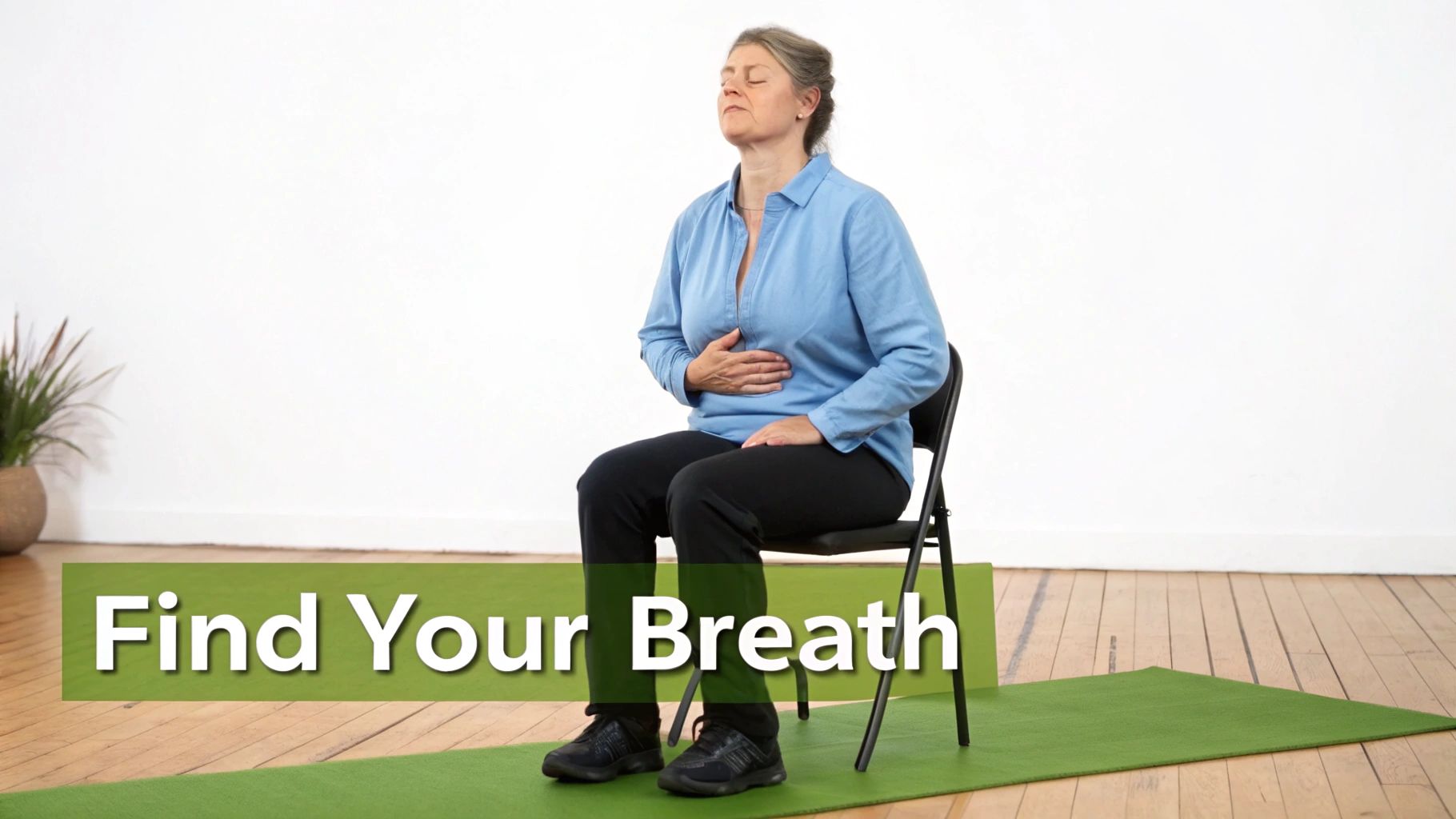
When anxiety ambushes you, it feels completely overwhelming. Your heart pounds, your breath gets short and shallow, and your mind spirals with worst-case scenarios. This is the classic fight-or-flight mechanism—an ancient alarm system that was great for outrunning predators but isn't so helpful when you're just trying to get through a stressful workday.
The secret to disarming this alarm is to consciously change how you breathe.
Instead of the tight, chest-level breaths that fuel panic, you can intentionally shift to slow, deep belly breaths. This simple action sends a direct signal to your brain to activate the parasympathetic nervous system—your body’s "rest and digest" mode. This isn't just a mental trick; it's a physiological command that tells your body it’s safe to stand down.
From Panic to Peace: The Physiological Shift
Understanding the real, physical impact of your breath can make the practice feel a lot more concrete. When you're anxious, your body is on high alert. When you practice controlled breathing, you're actively reversing those signals one by one.
Here’s a quick look at the physical changes you are creating with every intentional breath.
Anxiety Response vs Calm Breathing Response
When we're anxious, our breathing patterns change without us even realizing it, triggering a cascade of stress responses. Intentional breathing flips the script, sending calming signals instead. The table below breaks down the difference between how your body typically responds to anxiety and the goal of controlled breathing.
Physiological Sign | Typical Anxiety Response | Controlled Breathing Goal |
|---|---|---|
Breathing Rate | Rapid and shallow | Slow, deep, and rhythmic |
Heart Rate | Elevated and pounding | Lowered and stabilized |
Muscle Tension | Tight shoulders, clenched jaw | Muscles begin to relax |
Mental Focus | Racing, scattered thoughts | Grounded in the present moment |
As you can see, each intentional breath is a direct counter-command to the body’s panic signals.
The science backs this up, too. A huge systematic review analyzing numerous studies found that many reported statistically significant improvements in anxiety levels and stress reduction. Crucially, the review also emphasized how safe these techniques are as a therapeutic tool. You can read the full research about these findings for a deeper dive.
Making the Connection Feel Real
At first, just focusing on your breath can feel awkward, especially when your mind is screaming at you from a dozen different directions. That’s completely normal.
The goal isn't to empty your mind or achieve a perfect state of calm immediately. The goal is to interrupt the anxiety cycle, even for just one minute, by giving your mind a simple, grounding task to focus on.
To feel the difference for yourself, try this right now. Place one hand on your chest and the other on your belly. Take a normal breath. Which hand moved more? If you’re like most people, it was the hand on your chest.
The whole point of many breathing exercises for anxiety is to shift that movement down to your belly hand, making sure you’re taking a truly deep, calming breath.
How Breathing Actually Calms Your Nervous System
To get the most out of breathing exercises, it helps to understand they’re doing far more than just distracting you. This isn’t just a mental trick. You are tapping into a powerful biological process, sending a direct, physical signal to your brain that it’s time to stand down.
It all comes down to a part of your body's command center you might have heard of: the autonomic nervous system. Think of it like an automatic control panel running in the background, managing everything from your heart rate to your digestion. It has two main settings.
The "Fight or Flight" Accelerator
First, you have the sympathetic nervous system. This is your body's accelerator pedal. When it senses a threat—whether it’s a genuine danger, a looming work deadline, or even just an angry email—it hits the gas and triggers the classic "fight or flight" response.
This floods your system with adrenaline, making your heart pound, your breathing shallow and fast, and your muscles tighten. It’s an ancient survival mechanism that’s essential for emergencies. The problem is, in modern life, this system often gets stuck in the "on" position, leaving us in a state of chronic anxiety.
The "Rest and Digest" Brake Pedal
The other setting is the parasympathetic nervous system, which acts as the brake pedal. This is your "rest and digest" mode. Its job is to slow things down, promote calm, and help your body recover and conserve energy.
When this system is in charge, your heart rate lowers, your breathing deepens, and your body can finally relax. The catch is that you can’t just think your way into this state. You need to send your body a clear, physical signal that the danger has passed.
Your breath is the most direct and reliable signal you have. By intentionally slowing your breathing, you manually engage the parasympathetic nervous system, effectively telling your brain to pump the brakes on the anxiety response.
Hacking Your Nervous System with the Vagus Nerve
This isn't magic; it's pure physiology. The key messenger that allows you to "hack" this system is the vagus nerve. This is a long, wandering nerve that connects your brain to many of your major organs, including your heart and lungs.
When you take slow, deep breaths—especially when you make your exhale longer than your inhale—you physically stimulate the vagus nerve. This sends a powerful signal straight to your brainstem: "Everything is okay. You can relax now." Your brain then relays this message to the rest of your body, kicking off the calming cascade of the parasympathetic response.
Measuring Your Resilience with Heart Rate Variability
The amazing thing is that we can actually measure how well your body shifts between these states of high alert and calm. The metric for this is called heart rate variability (HRV).
HRV isn't about how fast your heart is beating. Instead, it measures the tiny, natural variations in time between each individual heartbeat.
Low HRV: Suggests your system is stuck in "fight or flight" mode. It's less adaptable and more vulnerable to stress.
High HRV: Shows your nervous system is balanced and resilient. It can switch gears efficiently from a state of stress to one of relaxation.
Think of HRV as a real-time indicator of your nervous system's health and your resilience to stress. The best part? You can actively improve it.
Consistently practicing controlled breathing exercises is one of the most effective ways to increase your HRV over time, building a stronger, more robust buffer against anxiety. You can learn more about how to interpret this data in our deep dive into the essentials of heart rate variability.
By using these techniques, you move from just hoping to feel better to actively managing your own physiology. You are taking the wheel of your nervous system, consciously guiding your body from a state of alarm back to one of grounded calm.
Alright, let's move from the science to the practice. This is where you get hands-on and learn to actively guide your nervous system back to a calmer state. We’ll walk through some of the most effective breathing exercises for anxiety, each with its own unique feel and perfect moment to be used.
Think of these less like rigid rules and more like tools in your mental wellness kit. You’ll quickly find which one feels most natural for grounding you, which one sharpens your focus before a big meeting, and which one provides the fastest relief when you feel completely swamped.
This simple visual shows exactly how slow, intentional breathing can transform anxiety into calm right inside your nervous system.
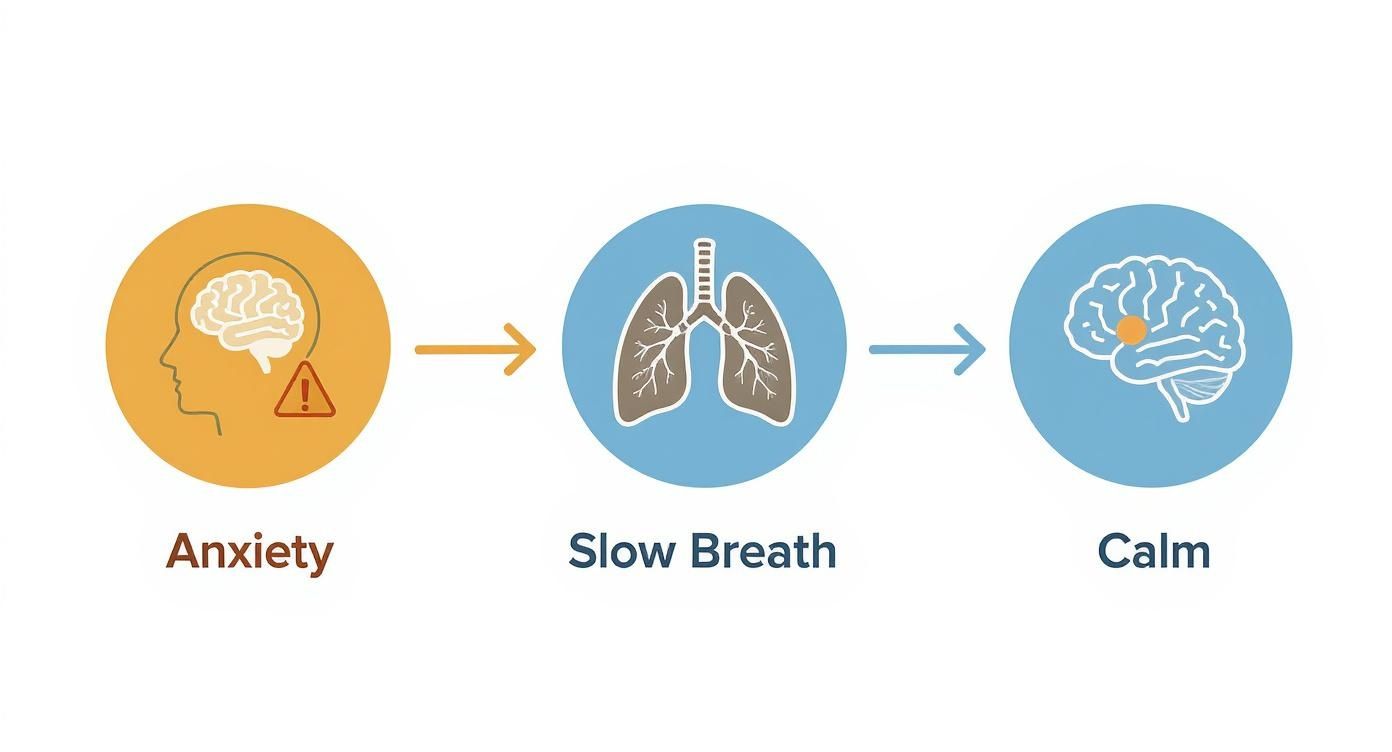
It’s all about interrupting the brain's alarm signal. When you deliberately slow your breath, you’re hitting the brakes on that "fight or flight" response and activating a profound sense of calm.
Diaphragmatic Breathing: The Foundation of Calm
This is the cornerstone of effective breathwork, often called "belly breathing" for a good reason. Most of us, especially when stressed, take short, shallow sips of air from our chests. Diaphragmatic breathing is about retraining your body to use its main breathing muscle—the diaphragm—for a deeper, more efficient, and incredibly calming breath.
How to Practice It:
Get comfortable, either sitting up straight or lying down. Place one hand on your upper chest and the other on your belly, just below your ribs.
Breathe in slowly through your nose for a count of four. Your goal is to feel your belly expand and push your hand out. The hand on your chest should barely move.
Now, breathe out slowly through your mouth for a count of six. Feel your belly gently fall as you release the air.
The key is that belly movement. Imagine you're inflating a small balloon in your stomach on the inhale and letting it slowly deflate on the exhale.
Real-World Scenario: You’re at your desk when a stressful email lands in your inbox. Your shoulders tense, your heart starts to pound. This is a perfect moment for a little discreet diaphragmatic breathing. Just rest a hand on your lap (over your belly) and take five deep belly breaths. No one will even notice.
Box Breathing: For Focus and Stability
Made famous by Navy SEALs, box breathing is a fantastic technique for calming your nerves and sharpening your focus when you’re under pressure. Its simple, rhythmic pattern gives your mind a steady anchor to cling to, making it incredibly effective before a nerve-wracking presentation or difficult conversation.
The structure is as simple as a square, with four equal sides.
Inhale for a count of four.
Hold your breath for a count of four.
Exhale for a count of four.
Hold the empty breath for a count of four.
This balanced pattern helps regulate your entire system, stopping the erratic breathing that so often fuels anxiety. Those holds are just as important as the breaths themselves; they create little pockets of stillness that can completely interrupt a panic cycle.
A Personal Tip: When you're just starting out, try visualizing a square. As you inhale, trace one side of the box in your mind. As you hold, trace the next, and so on. This adds a visual element that really helps keep racing thoughts from taking over.
Cyclic Sighing: The Ultimate Reset Button
For those moments of intense overwhelm, cyclic sighing is probably the most powerful tool you have for immediate relief. The technique is based on something our bodies do naturally—the physiological sigh—to reset our respiratory system and offload excess carbon dioxide.
Recent research has really put a spotlight on how well this works. A controlled trial showed that just five minutes of daily cyclic sighing lowered anxiety more significantly than box breathing. Participants using cyclic sighing also reported a bigger boost in positive mood compared to those who practiced mindfulness meditation. You can see the data for yourself and dive into the findings.
How to Practice It:
Take a deep breath in through your nose.
Before you exhale, take another short, sharp "top-up" inhale to completely fill your lungs.
Then, let out a long, full sigh through your mouth.
That’s one cycle. The magic here is that the double-inhale pops open the tiny air sacs (alveoli) in your lungs that can collapse under stress. This allows for a much more efficient gas exchange, which sends a rapid calming signal to your entire body.
When to Use It:
Imagine you’ve just gotten off a tense phone call or you're stuck in traffic and running late. You can feel that frustration and anxiety building in your chest. That's the perfect time for two or three rounds of cyclic sighing. It’s like a pressure-release valve that immediately dials down that feeling of being about to boil over.
Building a Consistent Breathwork Practice
Knowing how to use breathing exercises to pull yourself out of an anxiety spike is a powerful skill. But the real game-changer is building a foundation of calm so those spikes happen less often and feel way less intense when they do.
This is where we move beyond using these techniques as an emergency brake and start weaving them into the fabric of your daily wellness routine. The idea isn't to pile another stressful task onto your plate. It's about finding small, simple moments for intentional breathing within the life you’re already living.
Why Consistency Beats Intensity
When we start a new habit, it's tempting to go all-in. But with breathwork, longer and harder isn't always better. In fact, the opposite is usually true. Practicing for five minutes every single day does more to build resilience in your nervous system than one marathon 35-minute session on a Sunday.
Think of it like training a muscle. A few consistent reps each day build strength far more effectively than one exhausting, weekly workout. Every short practice reinforces the neural pathways that activate your body's relaxation response. This makes that state of calm easier and quicker to tap into when you really need it.
The objective is not perfection, but persistence. A consistent, even brief, daily practice trains your nervous system to default to calm instead of anxiety, fundamentally changing your baseline stress levels over time.
This proactive approach makes your nervous system more flexible and less reactive to whatever life throws at you. The research backs this up, too. One clinical study on guided breathing found that participants' anxiety scores plummeted by approximately 43%, while stress scores fell by about 44%. The control group? They saw almost no change, which really highlights the impact of a regular practice.
Overcoming Common Hurdles to a Daily Practice
The two biggest roadblocks I see are "I'm too busy" and "I always forget." Sound familiar? Luckily, we can design a practice that elegantly sidesteps both of these. The secret is to make it so easy and integrated that it becomes second nature.
The "I'm Too Busy" Solution: Habit Stacking
Stop trying to find new time in your day. Instead, piggyback your breathwork onto something you already do without thinking. This is a brilliant concept called habit stacking.
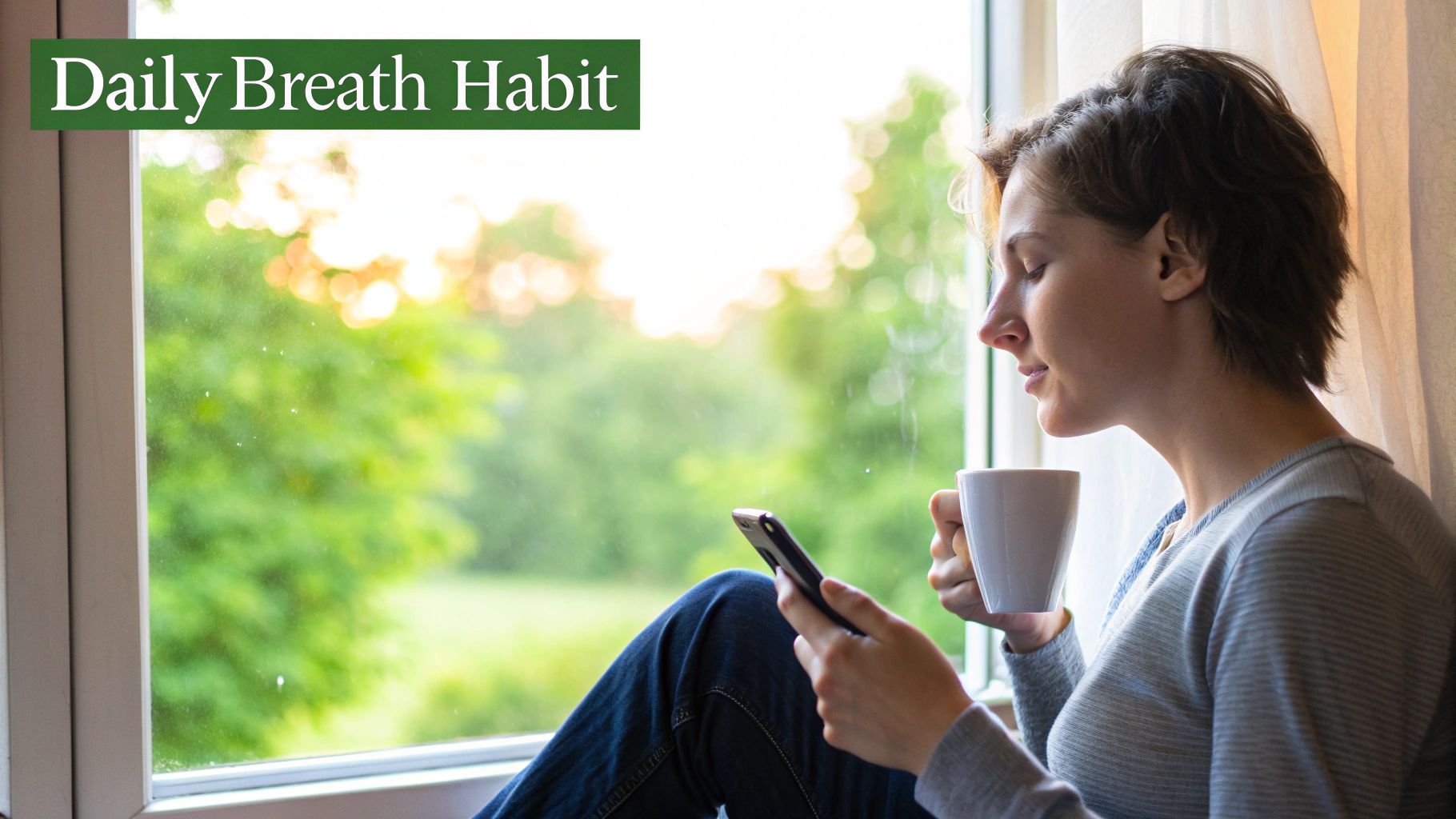
Morning Coffee Anchor: While your coffee is brewing—or right before you take that first glorious sip—do three to five rounds of Box Breathing.
Commute Cue: If you drive, use the first red light you hit as your trigger for some Diaphragmatic Breathing. On public transit? The moment you sit down is your cue to begin.
Bedtime Signal: Let your head hitting the pillow be the signal. Practice a few rounds of the 4-7-8 technique to tell your body it’s time to wind down.
By linking your breathing exercises for anxiety to an established habit, you take willpower and memory out of the equation. The old habit triggers the new one automatically.
The "I Always Forget" Solution: Tech and Environment Cues
If habit stacking isn't quite cutting it, use your environment and your phone to your advantage. A simple, non-intrusive nudge is often all you need to stay on track.
To keep your sessions from feeling stale, you might explore tools like a dedicated breathing exercises app. It can send gentle reminders and guide you through different techniques so you don't have to think about it.
Here are a few other simple ideas:
Set a daily alarm: A recurring alarm on your phone for midday can prompt a one-minute breathing break.
Use a visual cue: Stick a Post-it note that just says "Breathe" on your computer monitor or bathroom mirror.
Schedule it: Block out a five-minute slot in your digital calendar. Treat it with the same importance as any other appointment.
By making your practice small, linking it to what you already do, and using simple reminders, you turn breathwork from a chore into an effortless and sustainable part of your daily life.
Common Mistakes and How to Avoid Them
Getting started with breathwork is a fantastic step toward managing anxiety, but don't get discouraged if it feels a little strange at first. It’s completely normal to hit a few roadblocks when you’re retraining your body to breathe in a new, more intentional way.
Knowing what these common pitfalls are ahead of time can make the whole process smoother and much less frustrating.
One of the biggest mistakes I see is people breathing too forcefully. There's a misconception that a "deep" breath has to be a powerful, aggressive one. This can actually backfire, triggering dizziness or lightheadedness.
When you breathe too hard, you off-gas too much carbon dioxide, which can ironically amplify feelings of panic. The real goal is gentle and slow. Think of your breath like a slow tide rolling in and out, not a crashing wave. If you feel dizzy, just ease up and shorten the breath slightly until you feel grounded again.
The Chest Breathing Trap
Another major hurdle is falling back into shallow chest breathing instead of deep, diaphragmatic breathing. When we’re anxious, our muscles tense up, and breathing from the chest becomes our default stress pattern. You might be trying to breathe deeply, but your diaphragm muscle simply isn't getting the message.
This is where physical feedback is your best friend.
Put a hand on your belly: As you practice, focus on directing the air downward. You should feel your hand rise with every inhale and fall with every exhale.
Use a book: Lie on your back and place a light paperback on your abdomen. Your only job is to make that book rise and fall with each breath.
Lean forward: Sit in a chair and lean forward, resting your elbows on your knees. This position naturally helps your diaphragm engage.
These simple physical cues give you real-time feedback, making it much easier to guide your breath where it needs to go.
Don’t get frustrated if your mind wanders—it will. The practice isn't about achieving a perfectly empty mind. It's about gently noticing when your thoughts have drifted and kindly guiding your focus back to the sensation of your breath. Every time you do this, you strengthen your focus "muscle."
Setting Unrealistic Expectations
It’s also crucial to let go of the idea that you’ll find profound, instant calm in your very first session. While many people do feel an immediate shift, the real, lasting changes to your nervous system come from consistent, daily practice. Some days will feel effortless; others won't. That’s perfectly okay.
This applies to other health markers, too. While breathing exercises are incredible for stress, their benefits are wide-ranging. For instance, studies show they can have a significant impact on cardiovascular health. You can learn more in our guide on how breathing can help lower blood pressure quickly.
Ultimately, be patient and compassionate with yourself. You're learning a new skill. By anticipating these common hurdles—breathing too hard, defaulting to chest breathing, and expecting perfection—you can sidestep frustration and build a sustainable practice that truly supports you.
Your Questions About Breathing Exercises Answered
As you start weaving these powerful breathing techniques into your daily life, it’s only natural for a few questions to pop up. Getting those answered is key to building confidence and sticking with the practice long enough to really feel the benefits.
We've pulled together some of the most common queries we hear. Think of this as your go-to guide for fine-tuning your approach.
How Long Until Breathing Exercises Actually Work?
This is a great question. You’ll likely feel some immediate grounding right in the middle of an exercise—that’s the acute, in-the-moment relief. It’s that feeling of stopping a panic cycle right in its tracks.
But the real magic? That comes with consistency. The long-term shifts, like a lower baseline of anxiety and just feeling more resilient to stress, usually build up over several weeks of daily practice.
Think of it like physical exercise for your nervous system. Each session strengthens your body's ability to switch on its relaxation response, making calm your new default.
The trick is to focus on the process, not just the immediate result. Celebrate the small win of just doing it for five minutes. Trust that you're building a more resilient version of yourself with every single breath.
Can I Do These Breathing Exercises Anywhere?
Absolutely. This is one of their biggest advantages. While setting up a quiet, dedicated space is fantastic for a longer session, most of these techniques were made for real life. They're subtle enough to do almost anywhere without anyone noticing.
You can easily practice diaphragmatic breathing or a simple extended exhale in all sorts of situations.
At your desk right before a big presentation.
On your commute, sitting on the train or bus.
In a waiting room to dial down that anticipatory anxiety.
Standing in a grocery line when you feel that wave of overwhelm coming on.
The goal is to have a tool you can pull out anytime, anywhere. To practice discreetly, just rest a hand on your lap instead of your belly and focus internally on the feeling of your breath. No one will have a clue you’re actively calming your nervous system.
What If Focusing on My Breath Makes Me More Anxious?
First off, if this happens, know you're not alone. It's a surprisingly common experience. For some people, turning their attention inward can actually amplify the physical sensations of anxiety, creating a frustrating feedback loop. If this is you, don't try to force it. Just be gentle and change your approach.
Start with tiny increments. I'm talking 30 to 60 seconds at a time. The point is to build comfort and familiarity, not to power through discomfort.
You can also try shifting your focus to something external to take the pressure off. Listening to a guided breathing track, for instance, lets you concentrate on the instructor's voice instead of what's happening inside your body.
Another fantastic strategy is to focus only on the exhale. The exhale is the part of the breath cycle that naturally stimulates the vagus nerve and kicks in the relaxation response. By simply concentrating on a long, slow, gentle release of air, you can sidestep the intensity of focusing on the full cycle while still getting those calming benefits. Remember, this is about gentle practice, not perfection.
Ready to see how your breathing directly impacts your nervous system in real-time? With the Mindbreath app, you can use your phone's camera to measure your Heart Rate Variability (HRV) and get instant biofeedback. Track your progress, discover which exercises work best for you, and build a resilient mind, one breath at a time. Download Mindbreath and start your journey today at https://www.mindbreathapp.com.
Comments